It was time to do spring cleaning for our portfolio.
I decided to get rid of all very small positions. Some of them were initially small extremely risky bets - I recall labeling in blog as "lottery tickets" - shrinking to fraction of what was invested. These included Leading Edge Material Corp (ex. Tasman Metals position) and Nautilus Minerals Inc. (which actually could not be sold since there has been trading halt since Feb 21, 2019 due to restructuring).
There was also a small stake of Wabtec Corp. that we got from General Electric in connection to GE Transportation merge to Wabtec. Nothing wrong with that company except didn't want to stick to a very small position so the call was between adding some more at current valuation or getting rid of that altogether.
Few small Finnish corporations were also dumped as bad calls from my part based on too much reliance for analyst estimates for the "fair price" of these companies. Luckily small positions to start with so no significant damage done.
Once can get rid of Nautilus Minerals Inc. we are down to 23 companies.
Showing posts with label Nautilus Minerals. Show all posts
Showing posts with label Nautilus Minerals. Show all posts
Thursday, March 14, 2019


Sunday, March 13, 2016
Risky, Riskier, Exploration stage mining company
A reader asked about my opinion on latest developments in Nautilus Minerals (TSX: NUS). Let me comment more broadly this types of very risky investments. For that I want to bring in Tasman Metals (TSX.V: TSM) and Talvivaara also in the discussion.
Talvivaara is a Finnish mining company that used to be listed in both London and Helsinki stock exchanges. I have been following developments of these three mining companies for many years.
Let's start with Talvivaara for three important learnings:
1) Never ever look into past valuation or past stock price (consider those meaningless no matter how compelling story there is about what treasures lie in underground/water). Many investors kept pouring money into Talvivaara as the stock plummeted probably thinking they are getting it at discount.
2) You can still loose lot of money even if you buy stock at very low unit prices (e.g below 0,10 which may seem dirt cheap). The fact that unit price is in "penny stock" range is warning sign in itself. It means since listing of the stock things have gone badly south.
3) Worst possible thing can happen. The operating subsidiary of Talvivaara (Talvivaara Sotkamo Ltd) was declared bankrupt on November 6th, 2014.
Fortunately, I sold our Talvivaara positions in May 2012 and took severe losses from those. However, this was still before the end game and got some 2 euros per stock (which we were luckily investing into Nokia which did prove to be a lot better bet for turnaround).
Which reminds me of my tendency to keep too many turnaound bets at the same time.
That's never wise since the odds - in general and across many cases - are against spectacular turnaround (so you can expect to loose most of the time).
Anyhow, it's good to keep in mind that Talvivaara was far beyond exploration stage. Yet it failed completely. They had their first (and only) mine in ramp-up stage. And then too many things went wrong (including macro environment around mining industry translating to less demand & lower prices for all metals).
The other two I am about to discuss are exploration stage. That translates to much much higher risk than Talvivaara as Talvivaara made it to production. Very few exploration stage properties ever get that far.
- Think about it! -
I have used many times in my posts about Nautilus Minerals term "lottery ticket".
In June 2011, the estimate was that if all goes well production may commence on site at the Solwara 1 Project in the last quarter 2013.
Now, the estimate seems to be Q1 2018. Almost five years have passed and still production is approximately 2 years away.
Time is money. No wonder they need to raise money - again.
Compare the amount of shares now issued (~687 million) to the amount of common shares company has outstanding (~446 million) and to what they had outstanding in June 2011 (~156 million) and you get idea of how much stock has been diluted along the way. I can imagine this is very typical in this type of companies. But it also means your share of the potential "treasure" is getting smaller and smaller.
On the positive side, they are making progress with the production equipment and system.
I made some estimations back in 2011 about the revenue that could be extracted from Solwara 1.
The estimate was done with following metal prices.
Cu $9000/t, Au $1500/oz, Ag $35/oz, Zn $2200/t
Most of the value of the project lies in copper. The price of copper (Cu) is now under $5000.
Also Gold (Au) is below (now less than $1300/oz).
Any calculations I made about stock price level can be ignored (as company will much more shares at potential production stage than I estimated at the time).
Capital required to get into production has also ballooned over the course of the project.
I haven't looked at the latest prospectus on how much it's now.
The project is very risky. When in production they will have (to my recollection) only one production system. Any part of that system malfunctions and they are burning cash without producing.
Finally, let's look at the third example: Tasman Metals (TSX.V: TSM).
In mid 2013 things were still looking good. Tasman Metals was granted mining lease for it's flagship Norra Kärr heavy rare earth element (REE) project in Sweden. At that point in time the estimate was that mine construction could start late 2014 and produduction during 2016.
Didn't happen.
Recently Swedish Supreme Administrative Court canceled the Mining Lease for Norra Karr project. The company still holds Exploration License which it tries to extend. Tasman Metals have told they will curtail expenditure on the project and have decided not to renew exploration licenses for their smaller Swedish REE project (Olserum).
The stakes we once had in Nautilus Minerals and Tasman Metals have melted down to tiny ones.
I am keeping both for now for the fun of it. Until things start to look better in the mining industry as a whole, I do not want to increase our current (tiny) stakes in these companies.
Talvivaara is a Finnish mining company that used to be listed in both London and Helsinki stock exchanges. I have been following developments of these three mining companies for many years.
Let's start with Talvivaara for three important learnings:
1) Never ever look into past valuation or past stock price (consider those meaningless no matter how compelling story there is about what treasures lie in underground/water). Many investors kept pouring money into Talvivaara as the stock plummeted probably thinking they are getting it at discount.
2) You can still loose lot of money even if you buy stock at very low unit prices (e.g below 0,10 which may seem dirt cheap). The fact that unit price is in "penny stock" range is warning sign in itself. It means since listing of the stock things have gone badly south.
3) Worst possible thing can happen. The operating subsidiary of Talvivaara (Talvivaara Sotkamo Ltd) was declared bankrupt on November 6th, 2014.
Fortunately, I sold our Talvivaara positions in May 2012 and took severe losses from those. However, this was still before the end game and got some 2 euros per stock (which we were luckily investing into Nokia which did prove to be a lot better bet for turnaround).
Which reminds me of my tendency to keep too many turnaound bets at the same time.
That's never wise since the odds - in general and across many cases - are against spectacular turnaround (so you can expect to loose most of the time).
Anyhow, it's good to keep in mind that Talvivaara was far beyond exploration stage. Yet it failed completely. They had their first (and only) mine in ramp-up stage. And then too many things went wrong (including macro environment around mining industry translating to less demand & lower prices for all metals).
The other two I am about to discuss are exploration stage. That translates to much much higher risk than Talvivaara as Talvivaara made it to production. Very few exploration stage properties ever get that far.
- Think about it! -
I have used many times in my posts about Nautilus Minerals term "lottery ticket".
In June 2011, the estimate was that if all goes well production may commence on site at the Solwara 1 Project in the last quarter 2013.
Now, the estimate seems to be Q1 2018. Almost five years have passed and still production is approximately 2 years away.
Time is money. No wonder they need to raise money - again.
Compare the amount of shares now issued (~687 million) to the amount of common shares company has outstanding (~446 million) and to what they had outstanding in June 2011 (~156 million) and you get idea of how much stock has been diluted along the way. I can imagine this is very typical in this type of companies. But it also means your share of the potential "treasure" is getting smaller and smaller.
On the positive side, they are making progress with the production equipment and system.
I made some estimations back in 2011 about the revenue that could be extracted from Solwara 1.
The estimate was done with following metal prices.
Cu $9000/t, Au $1500/oz, Ag $35/oz, Zn $2200/t
Most of the value of the project lies in copper. The price of copper (Cu) is now under $5000.
Also Gold (Au) is below (now less than $1300/oz).
Any calculations I made about stock price level can be ignored (as company will much more shares at potential production stage than I estimated at the time).
Capital required to get into production has also ballooned over the course of the project.
I haven't looked at the latest prospectus on how much it's now.
The project is very risky. When in production they will have (to my recollection) only one production system. Any part of that system malfunctions and they are burning cash without producing.
Finally, let's look at the third example: Tasman Metals (TSX.V: TSM).
In mid 2013 things were still looking good. Tasman Metals was granted mining lease for it's flagship Norra Kärr heavy rare earth element (REE) project in Sweden. At that point in time the estimate was that mine construction could start late 2014 and produduction during 2016.
Didn't happen.
Recently Swedish Supreme Administrative Court canceled the Mining Lease for Norra Karr project. The company still holds Exploration License which it tries to extend. Tasman Metals have told they will curtail expenditure on the project and have decided not to renew exploration licenses for their smaller Swedish REE project (Olserum).
The stakes we once had in Nautilus Minerals and Tasman Metals have melted down to tiny ones.
I am keeping both for now for the fun of it. Until things start to look better in the mining industry as a whole, I do not want to increase our current (tiny) stakes in these companies.
Monday, July 25, 2011
Tuning portfolio risk lower
I decided to lower risk a little bit in the portfolio in the face of potential market disruption due to U.S debt ceiling.
Sold half of my BYD position (at loss).
Sold gold (at profit) to keep it inside 10% allocation range.
Sold half of Nautilus Minerals position (at profit).
Out of my all positions these I think BYD and Nautilus are most risky. Gold, on the other hand, is there to keep balance and to speculate. Now it was time to offload it a bit. I believe the gold bubble has still room to grow. So many debt problems and US may keep "printing" dollars ("QE3")..
Earlier this year I have been adding to many positions so before this we were about 0% cash. Now at approx. 5% cash. Planning to wait atleast until early August before putting the cash back to work.
Sold half of my BYD position (at loss).
Sold gold (at profit) to keep it inside 10% allocation range.
Sold half of Nautilus Minerals position (at profit).
Out of my all positions these I think BYD and Nautilus are most risky. Gold, on the other hand, is there to keep balance and to speculate. Now it was time to offload it a bit. I believe the gold bubble has still room to grow. So many debt problems and US may keep "printing" dollars ("QE3")..
Earlier this year I have been adding to many positions so before this we were about 0% cash. Now at approx. 5% cash. Planning to wait atleast until early August before putting the cash back to work.
Saturday, June 18, 2011
Nautilus Minerals revisited
Nautilus Minerals is the first company to commercially explore the ocean floor for copper, gold, silver and zinc deposits. It holds tenement licences and exploration applications in various locations in the western Pacific Ocean and is establishing a pipeline of prospects for development.
On July 14, 2010 I published an article about Nautilus Minerals (TSX/AIM: NUS), an exploration stage company. Since then it has become the most accessed article in my blog. I continue to hold a small position in Nautilus Minerals and have been following their progress in Solwara 1 project. I decided to write an update to the article since there has been significant progress in the pioneering project.

Based on information in the company news releases (latest released 14th of June at the time of writing) Solwara 1 project looks to be progressing nicely. However, the project is not yet sanctioned. If that would occur in the first half of 2011, then it is expected that production may commence on site at the Solwara 1 Project in the last quarter 2013.
Joint ventures established for mining and for production support vessel

Nautilus Minerals has formed a strategic partnership with German shipping company Harren & Partner. A joint venture (“Vessel JV”) will be formed to own and to operate a production support vessel for Solwara 1. Nautilus Minerals needs to pay 32 million euros for their share in vessel JV. Harren and Petromin will cover the rest. The production support vessel will cost 127 million euros.

The Government of Papua New Guinea has exercised its option for 30% stake in Nautilus Minerals Solwara 1 project (“Mining JV”). The government’s share of the JV will be held in Petromin PNG Holdings Ltd (“Petromin”). A payment between 20 and 25 million U.S dollars (USD) will be made by August 2011 pending an audit. The payment covers development and exploration costs until the date of grant of the mining lease (Jan 2011). From January 2011 onwards, Petromin will contribute funds to the project in proportion to its interest. The Government of Papua New Guinea also took 5% position in the holding company for vessel JV and has made an initial deposit of 1.8 million USD for it.
Mining equipment
The key components of the envisioned seafloor mineral production system are seafloor production tools, riser and lifting system and production support vessel. Seafloor Production Tools and Riser and Lifting System are scheduled for delivery in early 2013 and will be wholly owned by the Mining JV.

Permits for Solwara 1
• Environmental permit was granted already in 2009
• Mining Lease granted on January 2011 for 20 years.
Mineral Resources and Production estimate
43-101 Resource Estimate for Solwara 1 is still 870 kt Indicated (6.8% Cu, 4.8 g/t Au, 23 g/t Ag and 0.4% Zn) and 1300 kt Inferred (7.5% Cu, 7.2 g/t Au, 37 g/t Ag and 0.8% Zn) [1]. Anticipated daily production rate remains at an average of 3710 tonnes (1.3 Mtpa) excluding site initiation and shutdown. This should translate to annual production of 80kt of copper and 150,000 oz of gold. However, at this rate the Solwara 1 deposit won’t last very long (about two years). The beauty in the underwater mining is that the equipment can be easily relocated elsewhere. The company has not stated which deposit would be next in line for mining. The company does have a lot of promising prospects besides Solwara 1 but only Solwara 1 has an officieal 43-101 Resource Estimate at this point. Given the high daily cost for production support vessel and crew contracted for 8 years at $80.000/day, they need to have more deposits to leverage after Solwara 1 is exhausted.
Cost estimates
Total capital cost for Solwara 1 project excluding capital costs of the vessel JV (production support vessel) is now estimated to be 407 million USD according to recent information from the company. The earlier estimate [1] was 383 million USD including 17.5% contingency as well as ore transport barges. Due to changes in ownership, Nautilus Minerals is no longer the only one providing capital to Solwara 1 project.
Nautilus has decided to charter rather than purchase the barges. This increases operating costs. I calculated that operating cost per tonne would increased by 11.2% [the company has not stated this directly!]. Previous info was 70 USD per tonne (including 10% contingency) so my own estimate based on information available is now 78 USD per tonne.
Financial status
At the end of Q1 2011 the company had 139 million USD in cash and cash equivalents. The company stated that this would be sufficient for the next 12 months. On May 24, 2011 Nautilus Minerals Launches Marketed Public Offering to gather about C$150 million, but later (June 10) withdrew the proposed capital raising claiming “weak financial market conditions”.
Given that the company needs to invest still roughly 300 million USD before Solwara 1 is up and running, they will need more cash from somewhere. Looking at the cash balance and expected money inflow and outflow, my guestimate is that they need 210 million USD at minimum by end of 2013. They have committed to certain amount of exploration, they are spending approximately 12 million a year for G&A and so on. These expenses they need to cover on top of any Solwara 1 capital expenses.
At June 14th Nautilus Minerals reported to have 155,6 million common shares and 9,3 million options outstanding (average exercise price for the options being C$2.67). If they would issue shares (let’s say at around C$2.4 a share) to cover the over $200 million gap in financing they need to issue around 90 million shares more. That’s a lot. Whether they will get the money by issuing more shares or lend it, there will be more people and organisations tapping into the future profits.
Economics of Solwara 1
My assumptions:
• Out of estimated indicated mineral deposits 90% are there and can be extracted
• Out of estimated inferred mineral deposits 60% are there and can be extracted
• Yield recovery (from extracted ore taking into assumption supposedly all costs from royalties to PNG, processing, smelting and so on) as stated in the feasibility study [1]: 70% for copper, 59% for gold, 57% for silver and assuming 60% for zinc (no info found).
• Metals prices: Cu $9000/t, Au $1500/oz, Ag $35/oz, Zn $2200/t
• Metals sold at above prices
Using the above assumptions the indicated resources could be valued at 458 million USD and inferred resources at 555 million USD. Thus the total revenue for the project could be 1013 million USD. I say “could” because it is quite unlikely that all the assumptions will hold. For example, the company could enter into a streaming agreement in which they will get a specific sum of money upfront in the exchange of specific metal they will extract. Typically the money that can be got upfront is only a small fraction of what is calculated above. Companies that need capital in order to ramp up operations enter this type of agreements quite often.
Whatever the revenue from Solwara 1 will be, it looks like the most valuable asset there is copper (69% of calculated project value). Gold comes second with 26% of calculated project value. The rest (5%) is then divided between Silver and Zinc.
Given my estimate of 78 USD per tonne for operational costs and 2170 kt (thousand metric tonnes) of ore to extract, they will spend 169 million USD extracting the ore. That leaves 844 million USD for operational profit from Solwara 1. 70% of this, 591 million USD would go to Nautilus. Given all the operational costs and capital costs, it seems quite unlikely that shareholders will see any profit from Solwara 1 (in form of dividends). However, Solwara 1 is a stepping stone into a whole new industry.
If Nautilus Minerals is successful in Solwara 1, there should be plenty of money to be made in the areas the company has claimed. Nautilus Minerals has grants or applications in place for tenements covering approximately 600,000 km2 of prospective territory. The more projects they have after Solwara 1 the more profitable they will be (Solwara 1 pretty much covers all the needed investments for production system). If they fail with Solwara 1 for one reason or another, all bets are off. Being a shareholder, I naturally believe that they have a decent chance of pulling it off.
Note that Nautilus Minerals is a very high risk investment and like with any investment, you might end up losing a lot of money. The author holds shares of Nautilus Minerals (at the time of writing) and is willing to take the risk of potentially losing all of the capital involved. Please read the disclaimer in the rightmost column of the blog.
Source material:
• Company news releases for 2011
• [1] Offshore Production System Definition and Cost Study
On July 14, 2010 I published an article about Nautilus Minerals (TSX/AIM: NUS), an exploration stage company. Since then it has become the most accessed article in my blog. I continue to hold a small position in Nautilus Minerals and have been following their progress in Solwara 1 project. I decided to write an update to the article since there has been significant progress in the pioneering project.

Picture 1. A black smoker of a seafloor massive sulphide system. Copyright © Nautilus Minerals. Used with permission.

Picture 2. Ownership of Nautilus Minerals and joint ventures established for Solwara 1 project.

Picture 3. 3D model of production support vessel. Copyright © Nautilus Minerals. Used with permission.
The Government of Papua New Guinea has exercised its option for 30% stake in Nautilus Minerals Solwara 1 project (“Mining JV”). The government’s share of the JV will be held in Petromin PNG Holdings Ltd (“Petromin”). A payment between 20 and 25 million U.S dollars (USD) will be made by August 2011 pending an audit. The payment covers development and exploration costs until the date of grant of the mining lease (Jan 2011). From January 2011 onwards, Petromin will contribute funds to the project in proportion to its interest. The Government of Papua New Guinea also took 5% position in the holding company for vessel JV and has made an initial deposit of 1.8 million USD for it.
The key components of the envisioned seafloor mineral production system are seafloor production tools, riser and lifting system and production support vessel. Seafloor Production Tools and Riser and Lifting System are scheduled for delivery in early 2013 and will be wholly owned by the Mining JV.

Picture 4. Seafloor production system. Copyright © Nautilus Minerals. Used with permission.
Permits for Solwara 1
• Mining Lease granted on January 2011 for 20 years.
43-101 Resource Estimate for Solwara 1 is still 870 kt Indicated (6.8% Cu, 4.8 g/t Au, 23 g/t Ag and 0.4% Zn) and 1300 kt Inferred (7.5% Cu, 7.2 g/t Au, 37 g/t Ag and 0.8% Zn) [1]. Anticipated daily production rate remains at an average of 3710 tonnes (1.3 Mtpa) excluding site initiation and shutdown. This should translate to annual production of 80kt of copper and 150,000 oz of gold. However, at this rate the Solwara 1 deposit won’t last very long (about two years). The beauty in the underwater mining is that the equipment can be easily relocated elsewhere. The company has not stated which deposit would be next in line for mining. The company does have a lot of promising prospects besides Solwara 1 but only Solwara 1 has an officieal 43-101 Resource Estimate at this point. Given the high daily cost for production support vessel and crew contracted for 8 years at $80.000/day, they need to have more deposits to leverage after Solwara 1 is exhausted.
Cost estimates
Total capital cost for Solwara 1 project excluding capital costs of the vessel JV (production support vessel) is now estimated to be 407 million USD according to recent information from the company. The earlier estimate [1] was 383 million USD including 17.5% contingency as well as ore transport barges. Due to changes in ownership, Nautilus Minerals is no longer the only one providing capital to Solwara 1 project.
Nautilus has decided to charter rather than purchase the barges. This increases operating costs. I calculated that operating cost per tonne would increased by 11.2% [the company has not stated this directly!]. Previous info was 70 USD per tonne (including 10% contingency) so my own estimate based on information available is now 78 USD per tonne.
Financial status
At the end of Q1 2011 the company had 139 million USD in cash and cash equivalents. The company stated that this would be sufficient for the next 12 months. On May 24, 2011 Nautilus Minerals Launches Marketed Public Offering to gather about C$150 million, but later (June 10) withdrew the proposed capital raising claiming “weak financial market conditions”.
Given that the company needs to invest still roughly 300 million USD before Solwara 1 is up and running, they will need more cash from somewhere. Looking at the cash balance and expected money inflow and outflow, my guestimate is that they need 210 million USD at minimum by end of 2013. They have committed to certain amount of exploration, they are spending approximately 12 million a year for G&A and so on. These expenses they need to cover on top of any Solwara 1 capital expenses.
At June 14th Nautilus Minerals reported to have 155,6 million common shares and 9,3 million options outstanding (average exercise price for the options being C$2.67). If they would issue shares (let’s say at around C$2.4 a share) to cover the over $200 million gap in financing they need to issue around 90 million shares more. That’s a lot. Whether they will get the money by issuing more shares or lend it, there will be more people and organisations tapping into the future profits.
My assumptions:
• Out of estimated indicated mineral deposits 90% are there and can be extracted
• Out of estimated inferred mineral deposits 60% are there and can be extracted
• Yield recovery (from extracted ore taking into assumption supposedly all costs from royalties to PNG, processing, smelting and so on) as stated in the feasibility study [1]: 70% for copper, 59% for gold, 57% for silver and assuming 60% for zinc (no info found).
• Metals prices: Cu $9000/t, Au $1500/oz, Ag $35/oz, Zn $2200/t
• Metals sold at above prices
Using the above assumptions the indicated resources could be valued at 458 million USD and inferred resources at 555 million USD. Thus the total revenue for the project could be 1013 million USD. I say “could” because it is quite unlikely that all the assumptions will hold. For example, the company could enter into a streaming agreement in which they will get a specific sum of money upfront in the exchange of specific metal they will extract. Typically the money that can be got upfront is only a small fraction of what is calculated above. Companies that need capital in order to ramp up operations enter this type of agreements quite often.
Whatever the revenue from Solwara 1 will be, it looks like the most valuable asset there is copper (69% of calculated project value). Gold comes second with 26% of calculated project value. The rest (5%) is then divided between Silver and Zinc.
Given my estimate of 78 USD per tonne for operational costs and 2170 kt (thousand metric tonnes) of ore to extract, they will spend 169 million USD extracting the ore. That leaves 844 million USD for operational profit from Solwara 1. 70% of this, 591 million USD would go to Nautilus. Given all the operational costs and capital costs, it seems quite unlikely that shareholders will see any profit from Solwara 1 (in form of dividends). However, Solwara 1 is a stepping stone into a whole new industry.
Source material:
• Company news releases for 2011
• [1] Offshore Production System Definition and Cost Study
Wednesday, July 14, 2010
Nautilus Minerals
Exploration stage mining companies are sort of lottery tickets. You can loose pretty much all your money in investing in them or then you can make spectacular gains. It all depends on what the company finds and if the mineral deposits are feasible to mine.
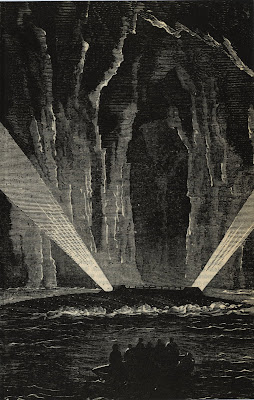
Last week, I took a small position in an exploration stage company called "Nautilus Minerals" (TSX/AIM: NUS). I am typically not interested in exploration stage companies, but this particular company does something that at first sounds like sci-fi: Their first mine will be located 1600 meters below the surface of Pacific Ocean near Papua New Guinea. In fact, long ago it was sci-fi. Jules Verne envisioned underwater mine in his book "Twenty Thousand Leagues under the Seas" back in 1870. I haven't read it, but I sure am familiar with Captain Nemo and Nautilus (the submarine) that were introduced by this book. It seems that Nautilus Minerals have taken their name from Nautilus the marine creature (not the sub) based on their logo.
Oil and gas industry went offshore in the 1940s and now it might be the time for mining companies to do the same. Nautilus Mining will use existing offshore oil technologies to cut ore from the seafloor and pump it to the surface as seawater slurry. Once the ore is dewatered, it will be shipped to shore for processing.
Recently published independent engineering study titled "offshore production system definition and cost study" related to the first ever underwater mine "Solwara 1" reveals some very interesting things. Indicated and inferred resources combined and valued at market prices for metals put the mineral deposit somewhere around 1,6 billion USD (at the time of writing). Most of this is copper (about 1 billion USD) and gold (about half a billion). Extraction requires 383 million USD capital expenses and approximately 150 million operating expenses (estimated based on $70 USD per tonne OPEX). The difference of resource value minus direct CAPEX and OPEX is over 1 billion USD. Naturally not all of this can be clarified as profit as there are other expenses involved in the process (such as smelting and refining).
Nautilus Minerals has about 169 million shares outstanding (diluted) and 196 million USD in cash (additional 40,7 million USD if all options etc. are excercised). The required CAPEX needs to come from somewhere. Either they have to issue more shares or then they need to sell some of the future revenue for cash today. So let's assume they sell more shares. Let's further assume that they can cover this by issuing 131 million shares putting total shares outstanding to 300 million.
Now, to justify the current share price of 2.11 CAD (about 2.05 USD) they would need to be able to make profits in the range of 600 million (net present value of future profits). If successful and completed within the CAPEX and OPEX estimates, the Solwara 1 alone should give this kind of profit with a healthy margin for error.
Yes, there are some very big IFs since this is a pioneering project. There are also big risks that the whole concept of underwater mining comes under attack for environmental or other reasons although the company claims that the environmental and social impacts are smaller than those associated with conventional land based mines. Also, between now and the completion of the mine, the company will have negative cash flow (Q1 2010: -13,3 million USD) due to exploration and other operating costs that are not related to mineral extraction from Solwara 1.
Solwara 1 was granted environmental permit in December 2009 and the company is expecting to have the mining lease in place during 2010. The company has over 450.000 square kilometers of tenements in five jurisdictions. There are many other high grade mineral deposits already found besides the Solwara 1.
Recently the stock has gained a lot and has been trading with wild daily swings up and down.
Last week, I took a small position in an exploration stage company called "Nautilus Minerals" (TSX/AIM: NUS). I am typically not interested in exploration stage companies, but this particular company does something that at first sounds like sci-fi: Their first mine will be located 1600 meters below the surface of Pacific Ocean near Papua New Guinea. In fact, long ago it was sci-fi. Jules Verne envisioned underwater mine in his book "Twenty Thousand Leagues under the Seas" back in 1870. I haven't read it, but I sure am familiar with Captain Nemo and Nautilus (the submarine) that were introduced by this book. It seems that Nautilus Minerals have taken their name from Nautilus the marine creature (not the sub) based on their logo.

The Nautilus, as pictured in "The Mysterious Island". Source: Wikipedia.
Oil and gas industry went offshore in the 1940s and now it might be the time for mining companies to do the same. Nautilus Mining will use existing offshore oil technologies to cut ore from the seafloor and pump it to the surface as seawater slurry. Once the ore is dewatered, it will be shipped to shore for processing.
Recently published independent engineering study titled "offshore production system definition and cost study" related to the first ever underwater mine "Solwara 1" reveals some very interesting things. Indicated and inferred resources combined and valued at market prices for metals put the mineral deposit somewhere around 1,6 billion USD (at the time of writing). Most of this is copper (about 1 billion USD) and gold (about half a billion). Extraction requires 383 million USD capital expenses and approximately 150 million operating expenses (estimated based on $70 USD per tonne OPEX). The difference of resource value minus direct CAPEX and OPEX is over 1 billion USD. Naturally not all of this can be clarified as profit as there are other expenses involved in the process (such as smelting and refining).
Nautilus Minerals has about 169 million shares outstanding (diluted) and 196 million USD in cash (additional 40,7 million USD if all options etc. are excercised). The required CAPEX needs to come from somewhere. Either they have to issue more shares or then they need to sell some of the future revenue for cash today. So let's assume they sell more shares. Let's further assume that they can cover this by issuing 131 million shares putting total shares outstanding to 300 million.
Now, to justify the current share price of 2.11 CAD (about 2.05 USD) they would need to be able to make profits in the range of 600 million (net present value of future profits). If successful and completed within the CAPEX and OPEX estimates, the Solwara 1 alone should give this kind of profit with a healthy margin for error.
Yes, there are some very big IFs since this is a pioneering project. There are also big risks that the whole concept of underwater mining comes under attack for environmental or other reasons although the company claims that the environmental and social impacts are smaller than those associated with conventional land based mines. Also, between now and the completion of the mine, the company will have negative cash flow (Q1 2010: -13,3 million USD) due to exploration and other operating costs that are not related to mineral extraction from Solwara 1.
Solwara 1 was granted environmental permit in December 2009 and the company is expecting to have the mining lease in place during 2010. The company has over 450.000 square kilometers of tenements in five jurisdictions. There are many other high grade mineral deposits already found besides the Solwara 1.
Recently the stock has gained a lot and has been trading with wild daily swings up and down.
Subscribe to:
Posts (Atom)