It was time to do spring cleaning for our portfolio.
I decided to get rid of all very small positions. Some of them were initially small extremely risky bets - I recall labeling in blog as "lottery tickets" - shrinking to fraction of what was invested. These included Leading Edge Material Corp (ex. Tasman Metals position) and Nautilus Minerals Inc. (which actually could not be sold since there has been trading halt since Feb 21, 2019 due to restructuring).
There was also a small stake of Wabtec Corp. that we got from General Electric in connection to GE Transportation merge to Wabtec. Nothing wrong with that company except didn't want to stick to a very small position so the call was between adding some more at current valuation or getting rid of that altogether.
Few small Finnish corporations were also dumped as bad calls from my part based on too much reliance for analyst estimates for the "fair price" of these companies. Luckily small positions to start with so no significant damage done.
Once can get rid of Nautilus Minerals Inc. we are down to 23 companies.
Showing posts with label Tasman Metals. Show all posts
Showing posts with label Tasman Metals. Show all posts
Thursday, March 14, 2019


Sunday, September 11, 2016
Portfolio change: Leading Edge Materials Corp
Just a small update on portfolio this time.
Our tiny position in Tasman Metals has now turned into tiny position in the Leading Edge Materials Corporation (TSX.v:LEM). The company was formed via merger of Tasman Metals Ltd. and Flinders Resources Limited.
The new company has two flagship projects in Sweden:
Tasman continues to own 100% of the Norra Karr project under exploration license while the mining lease application documentation is being reassessed.
From investment perspective the risk profile of the company didn't greatly improve via the merger from what is was before as exploration stage company.
Company continues to be a very high risk investment.
Our tiny position in Tasman Metals has now turned into tiny position in the Leading Edge Materials Corporation (TSX.v:LEM). The company was formed via merger of Tasman Metals Ltd. and Flinders Resources Limited.
The new company has two flagship projects in Sweden:
- Woxna (Graphite)
- Norra Kärr (Rare Earth Elements - REE)
Tasman continues to own 100% of the Norra Karr project under exploration license while the mining lease application documentation is being reassessed.
From investment perspective the risk profile of the company didn't greatly improve via the merger from what is was before as exploration stage company.
Company continues to be a very high risk investment.
Sunday, March 13, 2016
Risky, Riskier, Exploration stage mining company
A reader asked about my opinion on latest developments in Nautilus Minerals (TSX: NUS). Let me comment more broadly this types of very risky investments. For that I want to bring in Tasman Metals (TSX.V: TSM) and Talvivaara also in the discussion.
Talvivaara is a Finnish mining company that used to be listed in both London and Helsinki stock exchanges. I have been following developments of these three mining companies for many years.
Let's start with Talvivaara for three important learnings:
1) Never ever look into past valuation or past stock price (consider those meaningless no matter how compelling story there is about what treasures lie in underground/water). Many investors kept pouring money into Talvivaara as the stock plummeted probably thinking they are getting it at discount.
2) You can still loose lot of money even if you buy stock at very low unit prices (e.g below 0,10 which may seem dirt cheap). The fact that unit price is in "penny stock" range is warning sign in itself. It means since listing of the stock things have gone badly south.
3) Worst possible thing can happen. The operating subsidiary of Talvivaara (Talvivaara Sotkamo Ltd) was declared bankrupt on November 6th, 2014.
Fortunately, I sold our Talvivaara positions in May 2012 and took severe losses from those. However, this was still before the end game and got some 2 euros per stock (which we were luckily investing into Nokia which did prove to be a lot better bet for turnaround).
Which reminds me of my tendency to keep too many turnaound bets at the same time.
That's never wise since the odds - in general and across many cases - are against spectacular turnaround (so you can expect to loose most of the time).
Anyhow, it's good to keep in mind that Talvivaara was far beyond exploration stage. Yet it failed completely. They had their first (and only) mine in ramp-up stage. And then too many things went wrong (including macro environment around mining industry translating to less demand & lower prices for all metals).
The other two I am about to discuss are exploration stage. That translates to much much higher risk than Talvivaara as Talvivaara made it to production. Very few exploration stage properties ever get that far.
- Think about it! -
I have used many times in my posts about Nautilus Minerals term "lottery ticket".
In June 2011, the estimate was that if all goes well production may commence on site at the Solwara 1 Project in the last quarter 2013.
Now, the estimate seems to be Q1 2018. Almost five years have passed and still production is approximately 2 years away.
Time is money. No wonder they need to raise money - again.
Compare the amount of shares now issued (~687 million) to the amount of common shares company has outstanding (~446 million) and to what they had outstanding in June 2011 (~156 million) and you get idea of how much stock has been diluted along the way. I can imagine this is very typical in this type of companies. But it also means your share of the potential "treasure" is getting smaller and smaller.
On the positive side, they are making progress with the production equipment and system.
I made some estimations back in 2011 about the revenue that could be extracted from Solwara 1.
The estimate was done with following metal prices.
Cu $9000/t, Au $1500/oz, Ag $35/oz, Zn $2200/t
Most of the value of the project lies in copper. The price of copper (Cu) is now under $5000.
Also Gold (Au) is below (now less than $1300/oz).
Any calculations I made about stock price level can be ignored (as company will much more shares at potential production stage than I estimated at the time).
Capital required to get into production has also ballooned over the course of the project.
I haven't looked at the latest prospectus on how much it's now.
The project is very risky. When in production they will have (to my recollection) only one production system. Any part of that system malfunctions and they are burning cash without producing.
Finally, let's look at the third example: Tasman Metals (TSX.V: TSM).
In mid 2013 things were still looking good. Tasman Metals was granted mining lease for it's flagship Norra Kärr heavy rare earth element (REE) project in Sweden. At that point in time the estimate was that mine construction could start late 2014 and produduction during 2016.
Didn't happen.
Recently Swedish Supreme Administrative Court canceled the Mining Lease for Norra Karr project. The company still holds Exploration License which it tries to extend. Tasman Metals have told they will curtail expenditure on the project and have decided not to renew exploration licenses for their smaller Swedish REE project (Olserum).
The stakes we once had in Nautilus Minerals and Tasman Metals have melted down to tiny ones.
I am keeping both for now for the fun of it. Until things start to look better in the mining industry as a whole, I do not want to increase our current (tiny) stakes in these companies.
Talvivaara is a Finnish mining company that used to be listed in both London and Helsinki stock exchanges. I have been following developments of these three mining companies for many years.
Let's start with Talvivaara for three important learnings:
1) Never ever look into past valuation or past stock price (consider those meaningless no matter how compelling story there is about what treasures lie in underground/water). Many investors kept pouring money into Talvivaara as the stock plummeted probably thinking they are getting it at discount.
2) You can still loose lot of money even if you buy stock at very low unit prices (e.g below 0,10 which may seem dirt cheap). The fact that unit price is in "penny stock" range is warning sign in itself. It means since listing of the stock things have gone badly south.
3) Worst possible thing can happen. The operating subsidiary of Talvivaara (Talvivaara Sotkamo Ltd) was declared bankrupt on November 6th, 2014.
Fortunately, I sold our Talvivaara positions in May 2012 and took severe losses from those. However, this was still before the end game and got some 2 euros per stock (which we were luckily investing into Nokia which did prove to be a lot better bet for turnaround).
Which reminds me of my tendency to keep too many turnaound bets at the same time.
That's never wise since the odds - in general and across many cases - are against spectacular turnaround (so you can expect to loose most of the time).
Anyhow, it's good to keep in mind that Talvivaara was far beyond exploration stage. Yet it failed completely. They had their first (and only) mine in ramp-up stage. And then too many things went wrong (including macro environment around mining industry translating to less demand & lower prices for all metals).
The other two I am about to discuss are exploration stage. That translates to much much higher risk than Talvivaara as Talvivaara made it to production. Very few exploration stage properties ever get that far.
- Think about it! -
I have used many times in my posts about Nautilus Minerals term "lottery ticket".
In June 2011, the estimate was that if all goes well production may commence on site at the Solwara 1 Project in the last quarter 2013.
Now, the estimate seems to be Q1 2018. Almost five years have passed and still production is approximately 2 years away.
Time is money. No wonder they need to raise money - again.
Compare the amount of shares now issued (~687 million) to the amount of common shares company has outstanding (~446 million) and to what they had outstanding in June 2011 (~156 million) and you get idea of how much stock has been diluted along the way. I can imagine this is very typical in this type of companies. But it also means your share of the potential "treasure" is getting smaller and smaller.
On the positive side, they are making progress with the production equipment and system.
I made some estimations back in 2011 about the revenue that could be extracted from Solwara 1.
The estimate was done with following metal prices.
Cu $9000/t, Au $1500/oz, Ag $35/oz, Zn $2200/t
Most of the value of the project lies in copper. The price of copper (Cu) is now under $5000.
Also Gold (Au) is below (now less than $1300/oz).
Any calculations I made about stock price level can be ignored (as company will much more shares at potential production stage than I estimated at the time).
Capital required to get into production has also ballooned over the course of the project.
I haven't looked at the latest prospectus on how much it's now.
The project is very risky. When in production they will have (to my recollection) only one production system. Any part of that system malfunctions and they are burning cash without producing.
Finally, let's look at the third example: Tasman Metals (TSX.V: TSM).
In mid 2013 things were still looking good. Tasman Metals was granted mining lease for it's flagship Norra Kärr heavy rare earth element (REE) project in Sweden. At that point in time the estimate was that mine construction could start late 2014 and produduction during 2016.
Didn't happen.
Recently Swedish Supreme Administrative Court canceled the Mining Lease for Norra Karr project. The company still holds Exploration License which it tries to extend. Tasman Metals have told they will curtail expenditure on the project and have decided not to renew exploration licenses for their smaller Swedish REE project (Olserum).
The stakes we once had in Nautilus Minerals and Tasman Metals have melted down to tiny ones.
I am keeping both for now for the fun of it. Until things start to look better in the mining industry as a whole, I do not want to increase our current (tiny) stakes in these companies.
Sunday, October 20, 2013
Tasman Metals vs. peers
When writing my previous article on Tasman Metals, I noted that it would be useful to look at Competing HREE mines coming online elsewhere outside of China that might fill the same supply space. I started some work on this, but concentrated only on mines in or near Europe. A recently published article in Seeking Alpha seems to do this job rather nicely (as far as I can tell). I highly recommend it if you are interested about rare earth elements to begin with.
Best In Rare Earth Class And Undervalued: Tasman Metals" by "The Critical Investor".
I recommend to read also all of the comments, since there is some good discussion and alternative views there on the subject.
Also, I recommend listening to the recent interview with Mark Saxon, CEO of Tasman Metals by Gold Stock Trades Editor Jeb Handwerger in Youtube. "Tasman Metals: Critical Supply Of Heavy Rare Earths In EU"
The projects I managed to find in or near Europe were:
Storkwitz, located near the town of Delitzsch, is confirmed to contain JORC-compliant REE resource. In comparison to Norra Kärr the ore body in Storkwitz is much more difficult to access as it begins at 300 meters below surface and continues to greater depths trending straight down. It is currently estimated to contain 20100 tonnes rare earth oxides (half indicated and hald inferred). The drilling data covers up to 700 meters, but the ore body is estimated to possibly continue up to 1200 meters. In comparison, Norra Kärr ore body starts near surface and current drill holes are up to 150 meters making it feasible for open pit mining.
Kvanefeld in Greenland is potentially a huge project. Compared to Norra Kärr, the project is far bigger. Due to uranium it likely will also be more controversial. Resources are split to three different deposits within a grid of 7x8 kilometers. There does not seem to be infrastructure (roads, power..) so it is going to take more capital expenses than Norra Kärr. Target for operations to start is same as for Norra Kärr (~2016).
Note: all information about the projects in or near Europe where gathered in June before I finished my previous articled on Tasman Metals.
The author is long Tasman Metals and considers the investment as very high risk one as all junior miners typically are.
Best In Rare Earth Class And Undervalued: Tasman Metals" by "The Critical Investor".
I recommend to read also all of the comments, since there is some good discussion and alternative views there on the subject.
Also, I recommend listening to the recent interview with Mark Saxon, CEO of Tasman Metals by Gold Stock Trades Editor Jeb Handwerger in Youtube. "Tasman Metals: Critical Supply Of Heavy Rare Earths In EU"
The projects I managed to find in or near Europe were:
- Storkwitz deposit (Germany)
- Kvanefjeld project (Greenland)
- Kutessey II (Kyrgyzstan)
Storkwitz, located near the town of Delitzsch, is confirmed to contain JORC-compliant REE resource. In comparison to Norra Kärr the ore body in Storkwitz is much more difficult to access as it begins at 300 meters below surface and continues to greater depths trending straight down. It is currently estimated to contain 20100 tonnes rare earth oxides (half indicated and hald inferred). The drilling data covers up to 700 meters, but the ore body is estimated to possibly continue up to 1200 meters. In comparison, Norra Kärr ore body starts near surface and current drill holes are up to 150 meters making it feasible for open pit mining.
Kvanefeld in Greenland is potentially a huge project. Compared to Norra Kärr, the project is far bigger. Due to uranium it likely will also be more controversial. Resources are split to three different deposits within a grid of 7x8 kilometers. There does not seem to be infrastructure (roads, power..) so it is going to take more capital expenses than Norra Kärr. Target for operations to start is same as for Norra Kärr (~2016).
Note: all information about the projects in or near Europe where gathered in June before I finished my previous articled on Tasman Metals.
The author is long Tasman Metals and considers the investment as very high risk one as all junior miners typically are.
Tuesday, June 11, 2013
Tasman Metals Norra Kärr project: The beginning of a European REE supply chain?
China is currently dominating the supply of rare earth elements needed in many high tech products. Outside of China most advanced development projects targeting REE mining are in North America and Australia. In Europe Tasman Metals is currently leading activities in establishing a European REE supply chain.
The Norra Kärr project
On May 21st 2013 Tasman Metals Ltd (TSX.V : TSM; Frankfurt : T61; NYSE-MKT: TAS) reached a significant milestone. It was granted mining lease for it's flagship Norra Kärr heavy rare earth element (REE) project. The project is closing the midpoint in Tasman's own roadmap showing timeline from discovery to production. If all goes as planned the mine construction could start in late 2014 provided that they get extraction permit and the mine is found to be feasible. Production could start earliest in 2016 according to the roadmap that can be found from company presentation (slide #28 in May 2013 version).
The Norra Kärr project is located in southern Sweden, 15km north/north-east of the township of Gränna and 300km south-west of the capital Stockholm. It is NI 43-101 compliant resource together with Olserum REE deposit also in southern Sweden. Technical report for Olserum was published recently while for Norra Kärr Tasman has completed both Technical report and preliminary economic assessment (PEA) [reports].

Mineral resources vs. Ore Reserves
Mineral resources that are not mineral reserves do not have demonstrated economic viability. For relationship between mineral resources (inferred, indicated, measured) and ore reserves, please check the picture below as well as wikipedia entry for mineral resource classification.
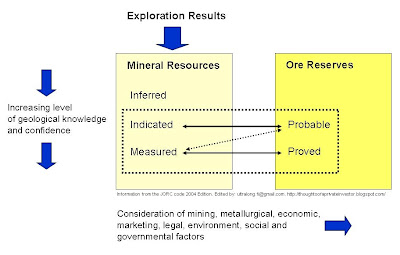
About Rare Earth Elements
Rare earth elements have geochemical properties that make them typically dispersed and not often found in concentrated and economically exploitable forms [Wikipedia]. These metals are used in many hi-tech devices. In particular, rare earth elements are used in clean energy applications such as wind turbines, electric vehicles, photovoltaic cells and energy-efficient fluorescent lighting. Clean energy technologies currently constitute only about 20 percent of global consumption of critical materials. However, their share of total consumption is expected to grow as the use of these clean energy technologies is expected to grow rapidly.
The rare-earth elements (REE) are naturally occurring non-toxic materials, whose unique properties make them essential to emerging technologies that contribute to environmental, energy efficiency and health solutions. Examples of use of REEs [source: Tasman Metals]:
Norra Kärr is source for Zirconium and the most critical rare earth elements
89% of revenue is expected to come from five metals:

+ Contains the most critical REEs
+ EU focus (as far as I can tell this is the best shot at EU securing own REE source)
+ very low in radioactive metals compared to most other REE deposits
+ very well serviced by local infrastructure
+ open pit mine and ore body starts near surface
- Competing HREE mines coming online elsewhere outside of China might fill the same supply space (subject to separate article)
- Tasman Metals is a very small company (junior resource company) with just $7 in cash (May 2013) so it will need help from partners in the project both technically and financially
- Risks in permitting and feasibility of the mine (as with any mine at this stage)
Key financials and facts from PEA:
Full disclosure: Author owns shares of Tasman Metals.
Warning!: This is a very high risk investment!
As Wikipedia puts it (referring to NI 43-101 "national instrument for the Standards of Disclosure for Mineral Projects within Canada"):
The Norra Kärr project
On May 21st 2013 Tasman Metals Ltd (TSX.V : TSM; Frankfurt : T61; NYSE-MKT: TAS) reached a significant milestone. It was granted mining lease for it's flagship Norra Kärr heavy rare earth element (REE) project. The project is closing the midpoint in Tasman's own roadmap showing timeline from discovery to production. If all goes as planned the mine construction could start in late 2014 provided that they get extraction permit and the mine is found to be feasible. Production could start earliest in 2016 according to the roadmap that can be found from company presentation (slide #28 in May 2013 version).
The Norra Kärr project is located in southern Sweden, 15km north/north-east of the township of Gränna and 300km south-west of the capital Stockholm. It is NI 43-101 compliant resource together with Olserum REE deposit also in southern Sweden. Technical report for Olserum was published recently while for Norra Kärr Tasman has completed both Technical report and preliminary economic assessment (PEA) [reports].

NI 43-101 Compliant Mineral Resource Estimate (March 2012); Norra Kärr
Approximately 50% of REE resources at Norra Kärr can be considered heavy REE. Preliminary economic assessment estimated Norra Kärr project net present value at 1,5 billion USD (Base case; 10% discount, REO basket price $51/kg). The deposit remains "open at depth" which basically means that there could be more economically viable mineralized ore deeper under the ground. Mine life is estimated at least 40 years.
Mineral resources vs. Ore Reserves
Mineral resources that are not mineral reserves do not have demonstrated economic viability. For relationship between mineral resources (inferred, indicated, measured) and ore reserves, please check the picture below as well as wikipedia entry for mineral resource classification.

About Rare Earth Elements
Rare earth elements have geochemical properties that make them typically dispersed and not often found in concentrated and economically exploitable forms [Wikipedia]. These metals are used in many hi-tech devices. In particular, rare earth elements are used in clean energy applications such as wind turbines, electric vehicles, photovoltaic cells and energy-efficient fluorescent lighting. Clean energy technologies currently constitute only about 20 percent of global consumption of critical materials. However, their share of total consumption is expected to grow as the use of these clean energy technologies is expected to grow rapidly.
The rare-earth elements (REE) are naturally occurring non-toxic materials, whose unique properties make them essential to emerging technologies that contribute to environmental, energy efficiency and health solutions. Examples of use of REEs [source: Tasman Metals]:
- A typical hybrid vehicle contains approximately 28 kg of REE
- Large wind turbine-generators units require 2 tonnes of high strength magnets, which contain approximately 30% REE (i.e. 600 kg or REE per generator)
- Catalytic converters that transform the primary pollutants in engine exhaust gases into non-toxic compounds have REE coating
- REE phosphors in compact fluorescent lamps and LED lamps.
- Flat screen and plasma televisions
- Hard disk drives
- REE permanent magnets to generate high strength magnetic fields for MRI imaging. 700 kg of magnets are consumed in each MRI machine
Norra Kärr is source for Zirconium and the most critical rare earth elements
89% of revenue is expected to come from five metals:
- Dysprosium (Dy) 35%
- Zirconium (Zr) 20%
- Neodymium (Nd) 13%
- Yttrium (Y) 11%
- Terbium (Tb) 10%


Medium term Criticality Matric. Source: Critical Materials Strategy, U.S DOE, 2010
- Dysprosium (Heavy REE) is used in permanent magnets for wind turbines and vehicles with electric drive trains.
- Neodymium (Light REE) is used in batteries for vehicles with electric drive trains and in permanent magnets for wind turbines and vehicles with electric drive trains.
- Terbium (Heavy REE) and Yttrium (Heavy REE) are used in fluorescent lighting phosphors.
Pros and Cons for Norra Kärr
+ Contains the most critical REEs
+ EU focus (as far as I can tell this is the best shot at EU securing own REE source)
+ very low in radioactive metals compared to most other REE deposits
+ very well serviced by local infrastructure
+ open pit mine and ore body starts near surface
- Competing HREE mines coming online elsewhere outside of China might fill the same supply space (subject to separate article)
- Tasman Metals is a very small company (junior resource company) with just $7 in cash (May 2013) so it will need help from partners in the project both technically and financially
- Risks in permitting and feasibility of the mine (as with any mine at this stage)
Key financials and facts from PEA:
- Market cap of Tasman Metals: 42,5 million USD (June 9th 2013; source: Google Finance NYSEMKT:TAS)
- Norra Kärr project net present value at 1,5 billion USD (Base case; 10% discount, REO basket price $51/kg).
- Initial capital expenditures of $290 million (includes contingency of $66.8 million or 30%)
- $5.3 Billion in revenue over the first 20 years and $10.9 billion over the 40 year life of mine
- Average annual operating expenses of $74.3 million or $10.93 per kg of mixed TREO concentrate output
Full disclosure: Author owns shares of Tasman Metals.
Warning!: This is a very high risk investment!
As Wikipedia puts it (referring to NI 43-101 "national instrument for the Standards of Disclosure for Mineral Projects within Canada"):
"The promulgation of a codified reporting scheme makes it more difficult for fraud to occur and reassures investors that the projects have been assessed in a scientific and professional manner. However, even properly and professionally investigated mineral deposits are not necessarily economic, nor does the presence of a NI 43-101-, JORC- or SAMREC and SAMVAL-compliant CPR or QPR necessarily mean that it is a good investment."
Thursday, March 22, 2012
Preliminary Economic Assessment (PEA) of the Norra Karr released by Tasman Metals
Tasman Metals Ltd (TSX.V : TSM; Frankfurt : T61; NYSE-AMEX: TAS) is a Canadian mineral exploration and development company focused on Strategic Metals in the European region. Today they released results of Preliminary Economic Assessment (PEA) of the Norra Karr heavy rare earth element (HREE) and zirconium (Zr) project in southern Sweden.
70% of the projected economic value of the project (86% of TREO revenue) is expected to be derived from the production of Norra Karr's four rare earth elements: dysprosium, terbium, neodymium and yttrium. Here is a summary of the most critical rare earths based on my earlier article "Critical Materials For Clean Energy Economy":

As you can see this project has potential to supply the most critical of the rare earth elements. If you are interested to read more about this company I recommend reading analysis what was done before the release of PEA, but still capture the essentials of the project risks and reward potential: http://seekingalpha.com/article/436991-tasman-metals-projected-fundamentals-support-buying-before-the-norra-karr-pea
The author of this arcticle was long Tasman Metals at the time of writing. Tasman Metals should be considered as high risk investment. As with all this type of investments, one must prepare for potential loss of entire capital invested.
Highlights:
- New "In Pit" mineral resource estimate of 41.6 Mt at 0.57% TREO with 51% HREO/TREO% and 1.70% Zr2O (Indicated), and 16.5 Mt at 0.64 % TREO with 49% HREO/TREO% and 1.70% Zr2O (Inferred);
- $1,464 million before-tax value (NPV at 10% discount rate) based on conservative basket price of US$51 per kg versus current China FOB basket price of US$184.85
- $5.3 Billion in revenue over the first 20 years
- 40 year mine life
- Initial capital expenditures of $290 million
- Before-tax payback period of 2.6 years
- Low start-up capital costs due to the excellent existing infrastructure at Norra Karr
- Proximal to operating ports with rapid access to the European market
70% of the projected economic value of the project (86% of TREO revenue) is expected to be derived from the production of Norra Karr's four rare earth elements: dysprosium, terbium, neodymium and yttrium. Here is a summary of the most critical rare earths based on my earlier article "Critical Materials For Clean Energy Economy":
As you can see this project has potential to supply the most critical of the rare earth elements. If you are interested to read more about this company I recommend reading analysis what was done before the release of PEA, but still capture the essentials of the project risks and reward potential: http://seekingalpha.com/article/436991-tasman-metals-projected-fundamentals-support-buying-before-the-norra-karr-pea
The author of this arcticle was long Tasman Metals at the time of writing. Tasman Metals should be considered as high risk investment. As with all this type of investments, one must prepare for potential loss of entire capital invested.
Friday, November 11, 2011
Interesting article about rare earth companies
Streetwise Reports interviewed recently John Kaiser the editor of Kaiser Research Online about rare earth companies. He singles out several companies that have a chance to be producing towards end of this decade (2016-2017) by stating: “The world does not need dozens and dozens of these deposits, however, which is why I think the race has already pretty much been wrapped up by companies Quest, Rare Element Resources, Tasman Metals and Avalon Rare Metals..”. He talks about companies with heavy rare earths prospects [Please check my earlier post about rare earths on why some rare earth elements are more rare than others].
His estimate is that Tasman’s Norra Karr deposit could take care of Europe’s needs for 50+ years. The problem with Norra Karr is that it “involves a mineral that has never been commercially exploited. So a key milestone is the publication of a preliminary economic assessment based on a bench scale-established metallurgical flow sheet that establishes the recoveries and the associated energy and reagent costs.”
Note that the following companies mentioned in the interview are sponsors of The Critical Metals Report: Commerce Resources, Quest Rare Minerals, Tasman Metals, Rare Element Resources. Note also that John Kaiser stated that he personally and/or his family own shares of the following companies mentioned in this interview: Quest Rare Minerals and Tasman Metals.
The author of this blog also owns shares in Tasman Metals at the time of writing (11/11/11). Please also note that investment into exploration stage companies is highly risky.
Tuesday, August 9, 2011
A European REE Play
I have been itching for some time to pick up a pure rare earth play and now the ongoing market turmoil has lowered the values of these companies to some extent. Therefore, I decided to put the money I got from selling half of Nautilus Minerals position to a small company called Tasman Metals. It is equally risky play: another lottery ticket if you will.
"Tasman Metals Ltd (TSX.V: TSM; Frankfurt : T61; Pink Sheets : TASXF) is a Canadian mineral exploration and development company focused on Strategic Metals in the European region."
They are pretty one the only ones having a serious prospect in Europe. Currently high tech companies in both Europe and U.S. are getting their REE metals from China. And China is cutting export quotas for REE metals each year. This is why stock prices of pretty much any serious REE play have been skyrocketing for the last year (many raising 500% or more). There might be some serious shortages in the next 5-10 years as it will take a long time to get the mines outside China rolling big time.
Their primary mineral prospect is located in Norra Kärr in Sweden. It contains a large inferred REE Mineral Resource with unique properties. REE content is tilted towards heavy rare earth elements that are more rare than the other rare earths (most mines coming online in the next 5 years will not provide a lot of heavy rare eart metals). It also does not have a lot of radioactive materials. Many potential REE mines do have radioactive materials mixed with REE to the degree that special permits might be required (depending on country).
They are also active in Finland where I live.
Note that Tasman Metals Ltd. is a very high risk investment and like with any investment, you might end up losing a lot of money. The author holds shares of the company (at the time of writing) and is willing to take the risk of potentially losing all of the capital involved. Please read the disclaimer in the rightmost column of the blog.
"Tasman Metals Ltd (TSX.V: TSM; Frankfurt : T61; Pink Sheets : TASXF) is a Canadian mineral exploration and development company focused on Strategic Metals in the European region."
They are pretty one the only ones having a serious prospect in Europe. Currently high tech companies in both Europe and U.S. are getting their REE metals from China. And China is cutting export quotas for REE metals each year. This is why stock prices of pretty much any serious REE play have been skyrocketing for the last year (many raising 500% or more). There might be some serious shortages in the next 5-10 years as it will take a long time to get the mines outside China rolling big time.
Their primary mineral prospect is located in Norra Kärr in Sweden. It contains a large inferred REE Mineral Resource with unique properties. REE content is tilted towards heavy rare earth elements that are more rare than the other rare earths (most mines coming online in the next 5 years will not provide a lot of heavy rare eart metals). It also does not have a lot of radioactive materials. Many potential REE mines do have radioactive materials mixed with REE to the degree that special permits might be required (depending on country).
They are also active in Finland where I live.
Note that Tasman Metals Ltd. is a very high risk investment and like with any investment, you might end up losing a lot of money. The author holds shares of the company (at the time of writing) and is willing to take the risk of potentially losing all of the capital involved. Please read the disclaimer in the rightmost column of the blog.
Subscribe to:
Posts (Atom)